Specifications · 4 min read
Coco peat specification for hydroponics and soilless growing
In soilless growing the substrate is the whole root zone, so there is no soil to buffer a poor batch. The specification you send to the exporter is the only control you have over what arrives. This is what it should contain and why.
By SK Ceylon ·
Why the specification matters more in soilless systems
In a field or a soil-based pot, a slightly salty or unbuffered amendment is diluted by the soil. In a grow bag, a slab or a container of pure coco peat, every property of the material acts directly on the root. Salts that arrive in the pith go straight into the root zone solution, cation exchange sites loaded with sodium and potassium pull calcium and magnesium out of the first weeks of feed, and a particle size that holds too much water drowns roots that have nowhere else to go. The remedy is a complete specification, with methods, agreed before production.
Chemical properties
| Property | Typical specification | Method to state | Notes |
|---|---|---|---|
| EC | < 0.5 mS/cm washed; buffered material similar after treatment | 1:5 v/v water extract, EN 13038, or 1:1.5 v/v | A 1:1.5 extract gives a higher number than 1:5 for the same material; never compare across methods |
| pH | 5.5 – 6.5 | Water suspension, EN 13037 | Coco peat is naturally in range and does not need lime |
| Sodium (Na) | Low, with a limit agreed per crop | Same extract as EC, reported in mg/L or mmol/L | The figure that EC alone can hide; important for salt-sensitive crops |
| Potassium (K) | Reported; reduced in buffered grades | Same extract as EC | Unbuffered pith releases K and binds Ca and Mg in the first weeks |
| Chloride (Cl) | Low, with a limit agreed per crop | Same extract as EC | Comes with sodium from coastal husk; washing removes most of it |
| Buffering | Buffered with calcium nitrate for fruiting crops on drip; washed unbuffered acceptable for short-cycle crops | State the treatment | See the guide to washed, unwashed and buffered grades |
EN 13038 and EN 13037 are the European methods for conductivity and pH in growing media and are widely used by independent laboratories. Many Dutch and other European growers work to the 1:1.5 volume extract instead, and some laboratories report both. Which method you choose matters less than stating it, because the same block can read 0.4 mS/cm by one method and 1.0 by another.
Physical properties
| Property | What to specify | Why |
|---|---|---|
| Particle size | A screen size, e.g. under 12 mm for fine peat, and the share of fines below 1 mm if your system is sensitive to it | Fines hold water and reduce air; coarse material drains and dries faster |
| Peat to chip ratio | e.g. 70:30 or 50:50 for grow bags and slabs; 100 % peat for propagation | Chips add air-filled porosity and drainage for crops irrigated many times a day |
| Fibre content | A maximum share of long fibre, or a statement that fibre is screened out | Fibre improves structure in small amounts and causes uneven wetting in large amounts |
| Air and water holding | Ask for the supplier’s measured air-filled porosity and water holding capacity for the blend, if available | These follow from particle size and ratio and are the figures your irrigation schedule depends on |
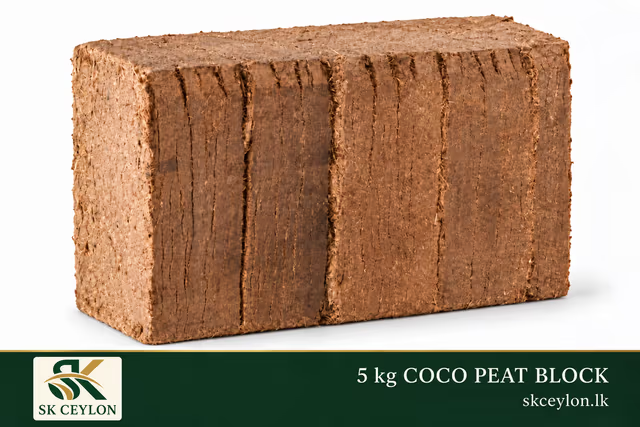
| Expansion | Minimum litres per kilogram, e.g. 12 L/kg, and the dry bulk density | Decides how much substrate a block, bag or bale actually gives you |
| Moisture at dispatch | A maximum, e.g. below 20 %, measured at packing | Wet material weighs more, costs more to ship and can mould in transit |
| Foreign matter | Free of stones, sand, plastic and weed seed; state a limit for sand if your source area is coastal | Sand raises bulk density and wears pumps and emitters |
Starting points by system
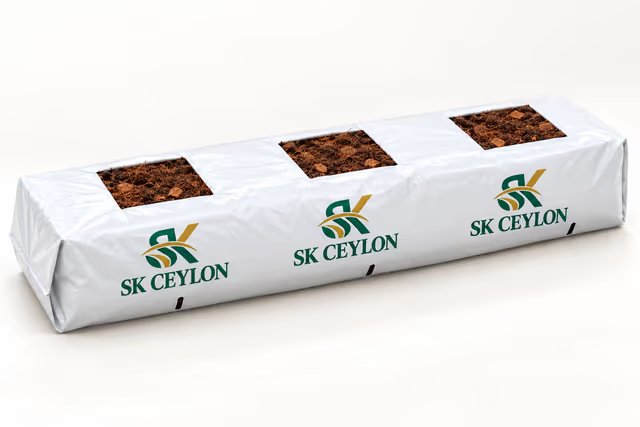
- Drip-irrigated fruiting crops in grow bags or slabs (tomato, cucumber, pepper, strawberry): buffered low-EC pith, 70:30 to 50:50 peat to chips depending on climate and irrigation frequency, screened to remove long fibre.
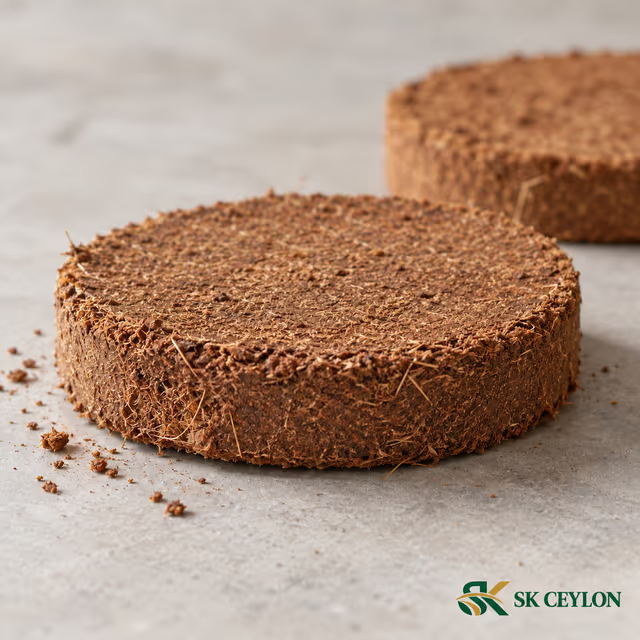
- Propagation plugs, discs and seedling trays: 100 % fine washed pith, often buffered, under 6 to 8 mm, with a tight EC limit because young roots are the most salt-sensitive.
- Container nursery and potting mixes: washed low-EC pith as a component with bark, perlite or compost; the mix supplier sets the final properties, so the pith specification can be a little wider.
- Flood and drain or ebb and flow benches: a coarser blend with more chips so that the medium drains between floods.
Sampling and testing each batch
A specification is only as good as the test that checks it. Ask the exporter for a batch sample and an independent lab report for every production run, with the sampling point stated. On arrival, hydrate a sample of blocks or bags from different pallets with the water you will use in production, let it stand, and test EC and pH with the method on the specification. Record the result against the lab report and the container number. Over a season this gives you a record of the supplier’s consistency that is worth more than any single certificate.