Choosing a grade · 4 min read
Coco peat vs peat moss: which growing medium should you buy?
Peat moss was the default substrate for a century. Coco peat now replaces it in most professional mixes. The two behave differently enough that switching needs a few recipe changes.
By SK Ceylon ·
What each one is
Sphagnum peat moss is partially decomposed moss harvested from drained bogs, mainly in Canada, the Baltic states and Ireland. The bogs took thousands of years to form and recover very slowly once cut. Coco peat, also called coir pith, is the spongy material left after fibre is extracted from coconut husks. Coconuts are harvested every year, so the supply renews with the crop.
Both are used for the same job: a lightweight, water-holding base for potting mixes, propagation and container growing. The differences are in chemistry and handling rather than in what they are for.
Side by side
| Property | Coco peat | Sphagnum peat moss |
|---|---|---|
| Natural pH | 5.5 – 6.5 | 3.5 – 4.5 |
| Lime needed before use | No | Yes, usually 3 – 6 kg per m³ |
| Rewetting after drying out | Easy; absorbs water readily | Difficult; dry peat repels water |
| Water-holding capacity | High | Very high |
| Air porosity | Good, and stable over the crop | Good when fresh; falls as it decomposes |
| Cation exchange capacity | High, loaded with K and Na | High, loaded with H |
| Soluble salts (EC) | Varies by grade; washed is < 0.5 mS/cm | Very low |
| Breakdown during use | Slow; high lignin content | Faster; shrinks and compacts |
| Shipping form | Compressed 5:1 in blocks, bales or slabs | Loose compressed bales, about 2:1 |
| Source | Annual coconut harvest by-product | Drained peat bog, slow to regenerate |
pH and lime
Peat moss is strongly acidic and is always limed before it goes into a mix, which adds a step, a cost and a source of batch variation. Coco peat arrives inside the range most crops want and needs no adjustment. The pH of coco peat does drift with the irrigation water over a long crop, so it is still worth checking the drain solution on a schedule, but there is no start-up correction.
Wetting and structure
The practical difference growers notice first is rewetting. A peat moss mix that dries out becomes hydrophobic: water runs down the gap between the root ball and the pot wall and out of the bottom. Coco peat takes water back up readily, which makes it more forgiving under drip irrigation and in retail where pots sit unwatered.
Coco peat also keeps its structure for longer. Peat moss continues to decompose in the pot, losing air space and compacting over a long crop. Coco peat is high in lignin and breaks down slowly, so air porosity in month six is close to what it was at planting. For long-cycle crops such as tomato, cucumber and soft fruit, this is the main reason the industry moved to coco slabs.
Nutrition and the first weeks
This is where switching needs care. Coco peat holds potassium and sodium on its exchange sites. In the first weeks of a crop it releases potassium and takes up calcium and magnesium from the feed, so a recipe written for peat moss will under-supply calcium on coco. Growers either order buffered coco peat, which has been pre-treated with calcium nitrate, or raise calcium and lower potassium in the starter feed.
Coco peat also carries more soluble salt than peat moss unless it is washed. For containers and propagation, specify washed low-EC material, under 0.5 mS/cm at 1:5 v/v. For salt-tolerant landscape use, unwashed material is fine and cheaper.
Cost and shipping
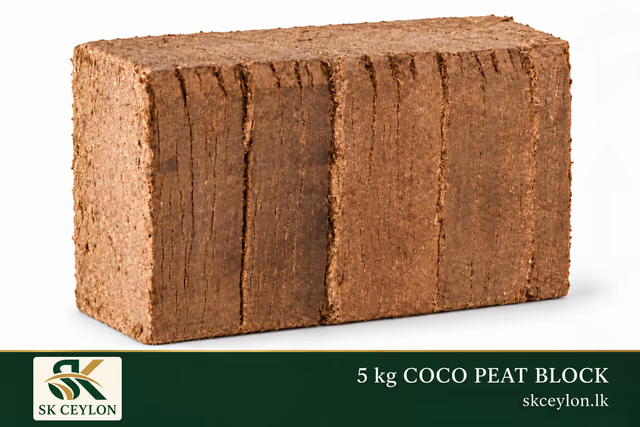
Coco peat ships at a 5:1 compression ratio, so a 40 ft high-cube container of 5 kg blocks expands to roughly 300 cubic metres of substrate. Peat moss bales are compressed about 2:1. Per cubic metre of finished mix delivered, coco peat is usually cheaper to freight even over a longer sea route, though the comparison depends on the destination and the moisture content shipped.
Sustainability and regulation
Peat bogs store large amounts of carbon, and harvesting releases it. Several European markets, the United Kingdom among them, are phasing out horticultural peat in retail and professional use, and many garden-centre chains and certification schemes already require peat-free mixes. Coco peat is the main replacement because it is the by-product of an existing crop and performs most like peat. Its own footprint is mostly sea freight and the fresh water used for washing, which is why the washing is done at the mill in Sri Lanka rather than at the destination.
Which to choose
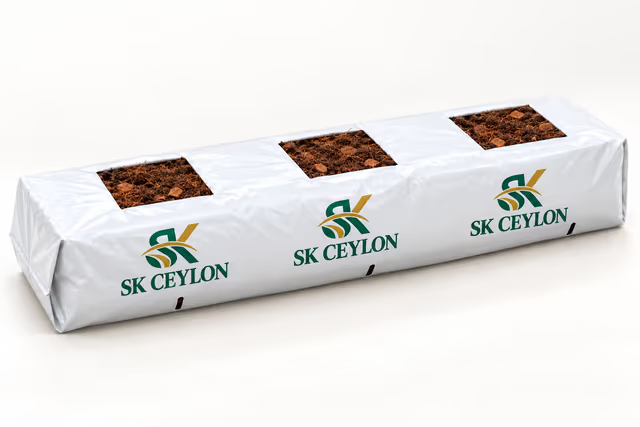
- Long-cycle fruiting crops on drip, such as tomato, cucumber, pepper and strawberry: coco grow bags, buffered.
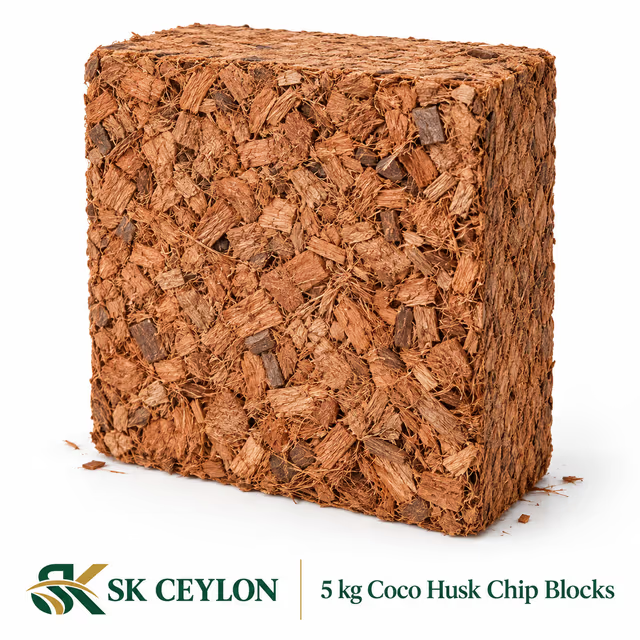
- Nursery and potting mixes, propagation plugs: washed low-EC coco peat blocks or discs, usually blended with chips or perlite for extra air.
- Mixes that must be peat-free for a certification scheme or retail customer: coco peat, with the EC and buffering specified on the order.
- Acid-loving crops such as blueberry and azalea: peat moss still has an edge because of its low pH, or coco peat with sulphur added to the feed.
- Existing peat recipes that cannot be reformulated: stay on peat, or blend coco in at 30 to 50 % as a first step.